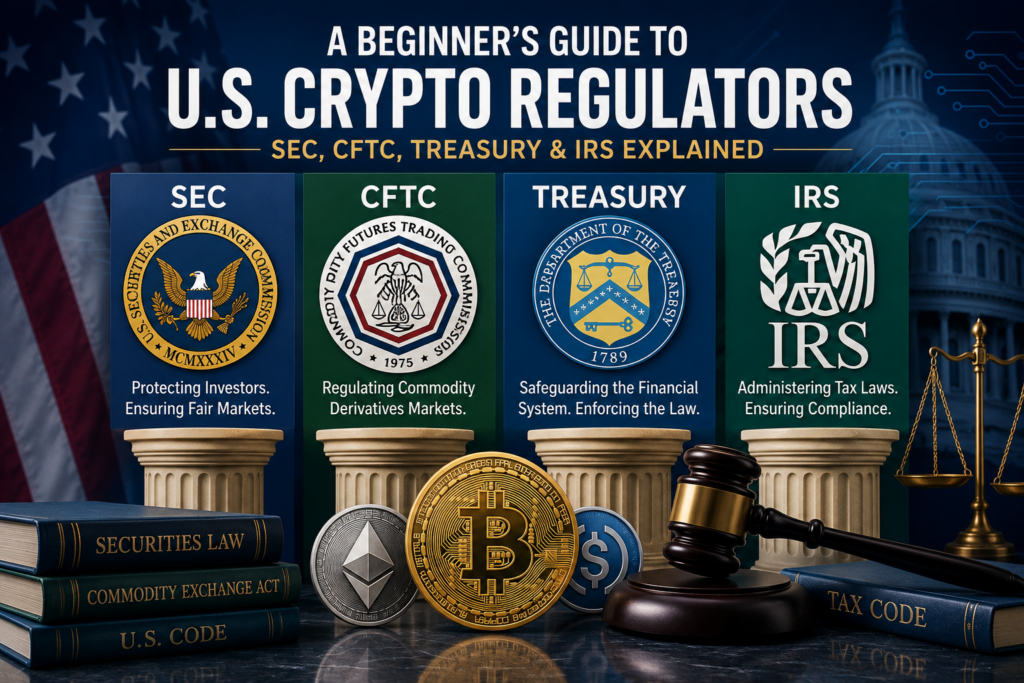
Understanding the SEC, CFTC, Treasury & IRS
If you’ve spent any time reading cryptocurrency news, you’ve probably seen headlines mentioning the SEC, CFTC, Treasury, or IRS.
But who are these agencies?
What do they actually do?
And why do their decisions move cryptocurrency markets?
Understanding these four organizations is one of the first steps toward becoming a more informed crypto investor.
Here’s what every investor should know.
Why There Isn’t Just One Crypto Regulator
Unlike traditional industries, cryptocurrency doesn’t fall neatly under a single federal agency.
That’s because digital assets can function in several different ways.
A cryptocurrency might be:
- An investment
- A commodity
- A payment system
- A technology platform
- A financial product
- A taxable asset
Each of those activities falls under different federal laws, which means different agencies have oversight.
That’s why multiple regulators are involved.
Securities and Exchange Commission (SEC)
Primary Mission
Protect investors and oversee securities markets.
What the SEC Does
The SEC regulates stocks, bonds, mutual funds, public companies, investment advisers—and, in certain situations, digital assets.
The agency’s biggest question regarding cryptocurrency has been:
“Is this token a security?”
If the answer is yes, the issuer may be required to comply with federal securities laws.
That could include:
- Registration requirements
- Investor disclosures
- Financial reporting
- Compliance obligations
- Anti-fraud provisions
Why Investors Should Care
When the SEC announces enforcement actions or new guidance, markets often react immediately.
A determination that a digital asset may be considered a security can affect:
- Exchange listings
- Trading volumes
- Institutional investment
- Company valuations
- Investor confidence
Think of the SEC As…
The referee responsible for ensuring investors receive accurate information and that securities markets operate fairly.
Commodity Futures Trading Commission (CFTC)
Primary Mission
Regulate commodity derivatives markets.
What the CFTC Does
The CFTC oversees futures, options, and derivatives tied to commodities.
Many cryptocurrencies—particularly Bitcoin—have been treated as commodities for certain regulatory purposes.
This gives the CFTC authority over:
- Bitcoin futures
- Commodity derivatives
- Certain crypto fraud and manipulation cases
- Futures exchanges
Why Investors Should Care
If you’re trading crypto futures or watching institutional participation, the CFTC plays an important role.
Its decisions can influence:
- Futures markets
- Market integrity
- Institutional trading
- Risk management
Think of the CFTC As…
The referee for commodity and futures markets.
U.S. Department of the Treasury
Primary Mission
Protect the financial system.
What Treasury Does
Treasury’s responsibilities extend well beyond cryptocurrency.
Within crypto, Treasury focuses on:
- Financial crime
- Anti-money laundering (AML)
- National security
- Sanctions enforcement
- Financial stability
- Payment systems
Several Treasury offices play important roles in crypto policy.
These include:
- Financial Crimes Enforcement Network (FinCEN)
- Office of Foreign Assets Control (OFAC)
- Other policy offices that develop recommendations affecting digital assets
Why Investors Should Care
Treasury policies can affect:
- Stablecoin regulation
- Exchange compliance
- International transactions
- Know Your Customer (KYC) requirements
- Banking relationships
- Global crypto adoption
Think of Treasury As…
The agency responsible for protecting the U.S. financial system from illicit activity while helping shape national financial policy.
Internal Revenue Service (IRS)
Primary Mission
Collect taxes and administer federal tax law.
What the IRS Does
The IRS views cryptocurrency primarily as property for federal tax purposes.
That means many crypto transactions may create taxable events.
Examples include:
- Selling cryptocurrency
- Trading one cryptocurrency for another
- Spending cryptocurrency
- Receiving staking rewards
- Mining income
- Certain airdrops
Why Investors Should Care
Taxes can significantly affect investment returns.
Keeping accurate records of purchases, sales, transfers, and income may simplify tax reporting and help avoid surprises.
Think of the IRS As…
The scorekeeper that determines how cryptocurrency transactions are taxed.
How These Agencies Work Together
Many investors assume these agencies compete.
In reality, they often oversee different parts of the same ecosystem.
Imagine a cryptocurrency exchange.
The SEC may examine whether certain listed assets are securities.
The CFTC may oversee derivatives trading.
Treasury focuses on anti-money laundering compliance and sanctions.
The IRS ensures taxable transactions are properly reported.
Each agency approaches digital assets through its own statutory authority.
Why Crypto Policy Can Be Confusing
Cryptocurrency evolves faster than legislation.
Many federal laws governing financial markets were written decades before blockchain technology existed.
As a result:
- Congress considers new legislation.
- Regulators issue guidance.
- Courts interpret existing law.
- Agencies coordinate (and sometimes disagree) over jurisdiction.
That evolving framework explains why regulatory developments often make headlines and why investors should pay close attention to policy changes.
What Crypto Policy Report Covers
At Crypto Policy Report, we’ll help you follow:
- Congressional legislation
- SEC actions and guidance
- CFTC developments
- Treasury announcements
- IRS tax guidance
- Federal court decisions
- Executive branch policy
- State-level crypto legislation
- International regulatory developments
Most importantly, we’ll explain why these developments matter—without unnecessary jargon or political spin.
Final Thoughts
The future of cryptocurrency won’t be shaped by technology alone.
It will also be shaped by legislation, regulation, court decisions, and public policy.
Understanding the roles of the SEC, CFTC, Treasury, and IRS gives investors a stronger foundation for interpreting the headlines that move markets.
That’s exactly why Crypto Policy Report exists: to translate complex policy into clear, practical insights for investors.